
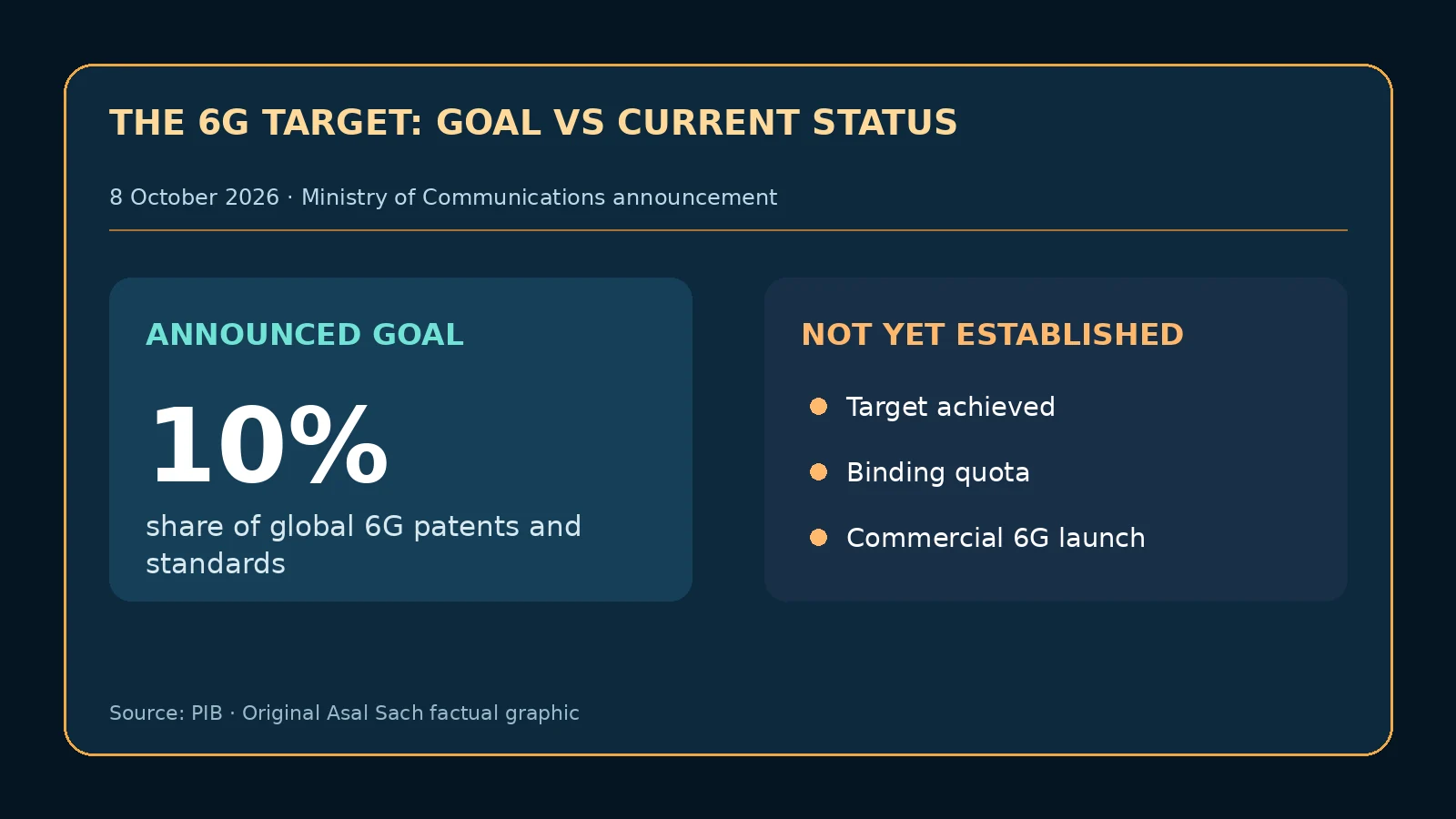
India’s government said on October 8 that it is targeting at least 10% of global 6G patents and standards. Minister of State for Communications Chandra Sekhar Pemmasani, speaking at a CTO round table during India Mobile Congress 2026 in New Delhi, asked major telecom operators to set measurable annual and quarterly goals for contributions to standards, standard-essential patents and university research. The target is a stated policy ambition, not evidence that India already holds that share.
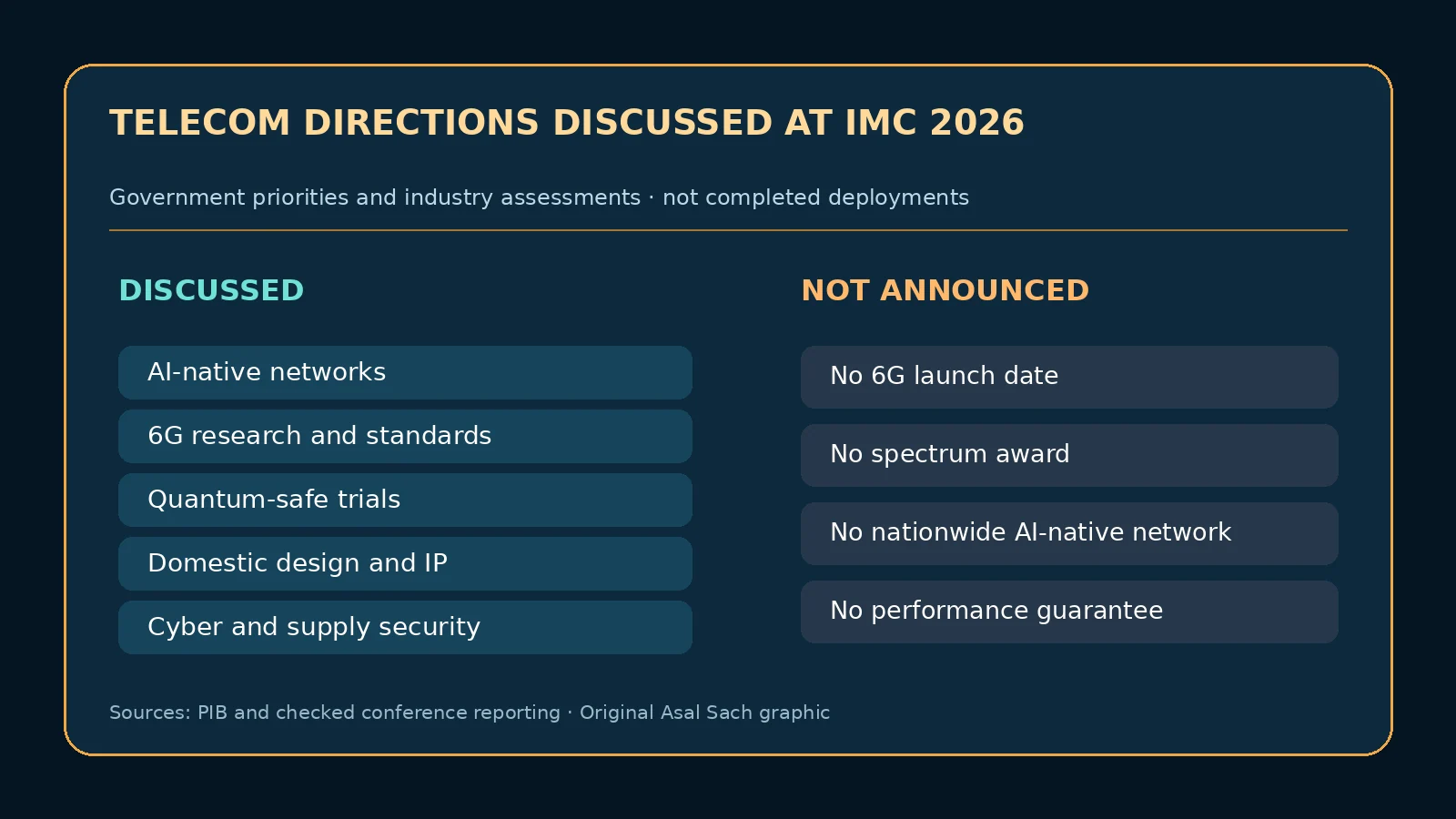
A Press Information Bureau release said nearly 136 research projects worth about ₹500 crore have been funded through the Telecom Technology Development Fund. It listed 5G, 6G, quantum communications, non-terrestrial networks, advanced optical systems, indigenous core technology and telecom security among the areas covered. The minister also called for operator trials of quantum-safe encryption and for networks to move from using AI as an assistant toward being designed around AI.
At a separate conference discussion reported by ANI and the Economic Times, Ericsson’s India-region chief Andres Vicente said a transition to 5G Standalone could make networks more programmable and support differentiated services before an eventual move toward 6G. GSMA director-general Vivek Badrinath said future value would depend not only on connectivity but also on compute, models, data and skills. These were speakers’ assessments, not announced deployment commitments.
Qualcomm industry-standards chair Etienne Chaponniere said AI could become a new user interface and that more processing may move onto devices. TIM executive Giacomo Robustelli described AI as an infrastructure shift likely to increase demand for connectivity, computing, storage and security. The comments describe expected technology and market directions; they do not establish a commercial 6G launch date or guarantee particular network performance.
Bharat 6G Alliance chair N. G. Subramaniam argued for mission-oriented research, while C-DOT chief Rajkumar Upadhyay said India should move beyond manufacturing toward domestic design, intellectual property and equipment, with attention to quality, cybersecurity and supply-chain security. Communications Minister Jyotiraditya Scindia separately said a CEO round table discussed advanced networks, AI, indigenous capability and resilient digital infrastructure.
The verified development is therefore an official target and a set of government and industry priorities presented at IMC 2026. The releases did not announce a binding patent quota, a finished AI-native national network, a 6G spectrum award or a commercial rollout timetable. Progress will have to be judged later through published standards contributions, patents, trials, procurement and independently verifiable deployments.