
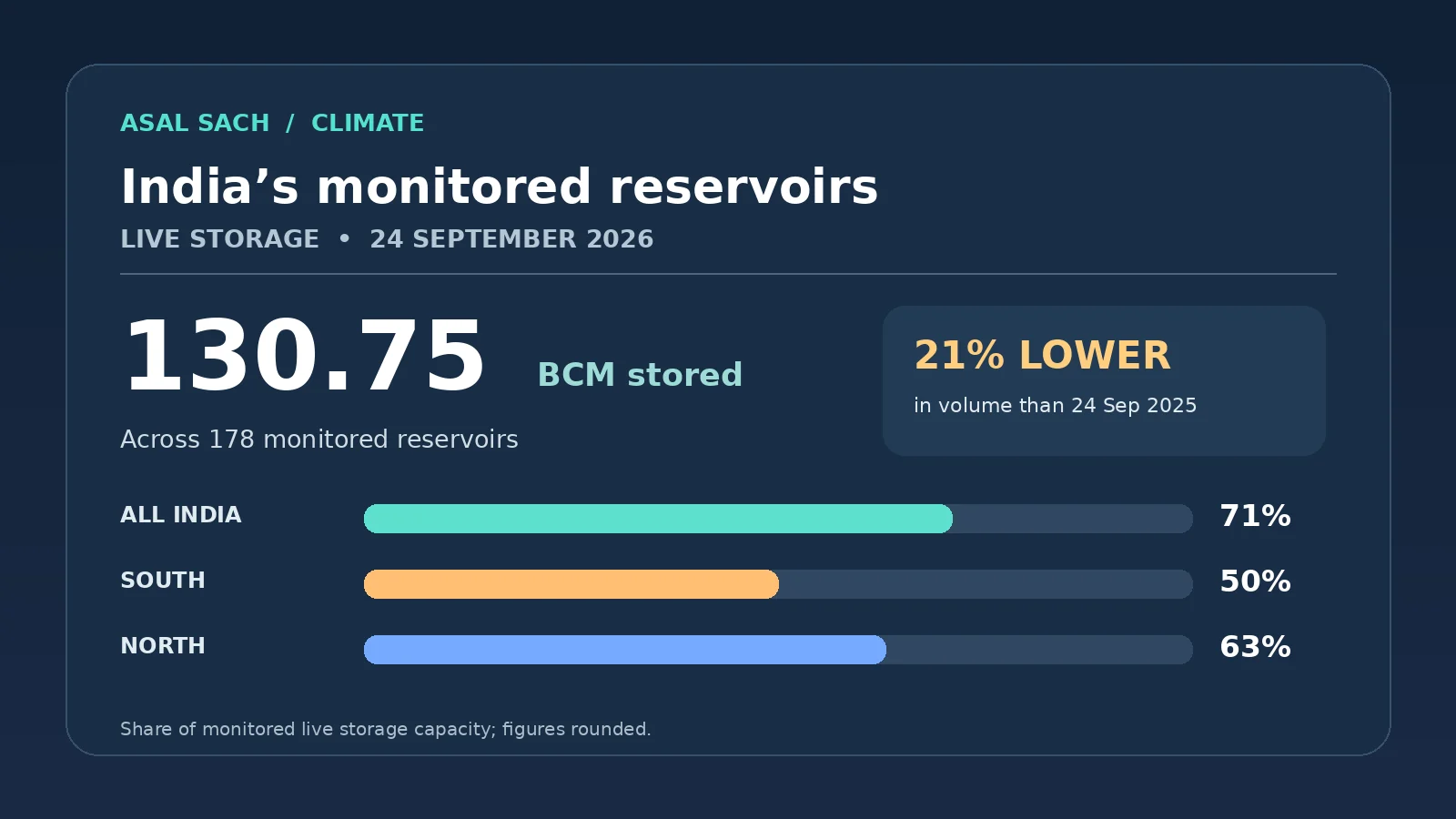
India’s 178 key reservoirs held 130.75 billion cubic metres of water on September 24, according to figures attributed to the Central Water Commission. That was about 71% of their combined live storage capacity. The same monitored set held 165.88 billion cubic metres at this point in 2025, making the current volume about 21% lower year on year. These are figures for monitored reservoirs, not a measure of every river, well or water source in India.
The regional gap is substantial. Fifty monitored reservoirs in the southern states held about 27.93 billion cubic metres, or half of their live capacity; the comparable share a year earlier was about 87%. Eleven northern reservoirs held about 12.43 billion cubic metres, around 63% of capacity. The southern grouping covers Andhra Pradesh, Telangana, Karnataka, Kerala and Tamil Nadu; the northern grouping covers Himachal Pradesh, Punjab and Rajasthan. A regional average cannot tell residents the condition of every dam or district.
The all-India volume was only slightly above the 130.55 billion cubic metres recorded on September 10, despite rain in some places during the intervening fortnight. In contrast to the south and north, monitored reservoirs in the western and central regions stood at about 85% and 86% of capacity on September 24. The uneven distribution matters for planning irrigation, hydropower and drinking-water releases as the southwest monsoon season approaches its scheduled September 30 end.
Lower storage raises concern for the coming dry months, especially where farms depend on reservoirs, but the snapshot does not by itself prove an immediate household shortage or establish drought in every state. Rainfall, groundwater, transfers between systems and decisions about releases will affect local outcomes. The figures should be checked against later weekly readings before drawing conclusions about the full post-monsoon water position.