
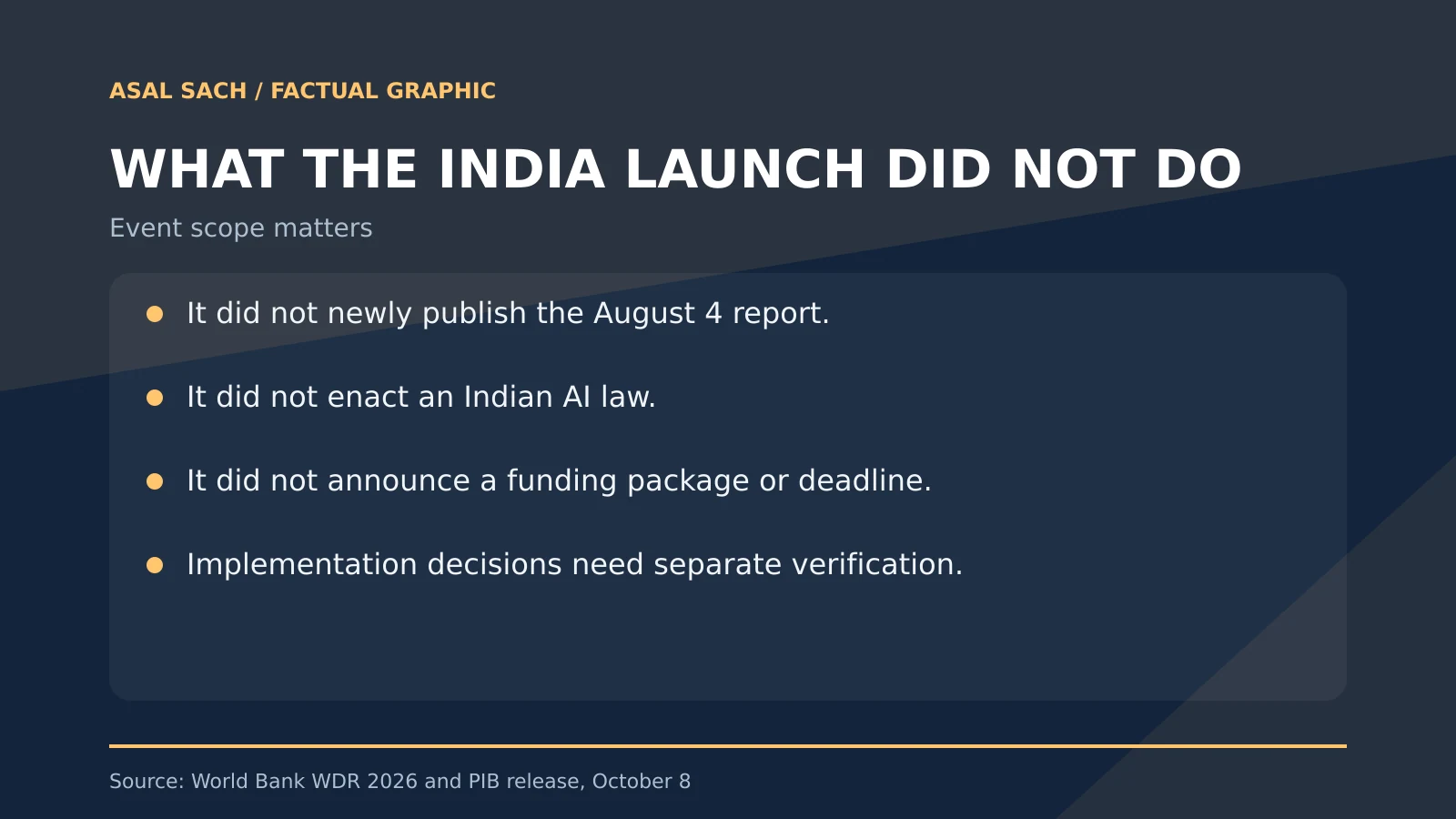
India hosted the national launch of the World Bank Group’s World Development Report 2026, The Promise of Artificial Intelligence, in New Delhi on October 8. Electronics and Information Technology Minister Ashwini Vaishnaw launched the report at an event organised by IndiaAI, the Ministry of Electronics and Information Technology and the World Bank. The report itself was published on August 4, so the new event was its India launch and policy discussion—not the first global release of the document.
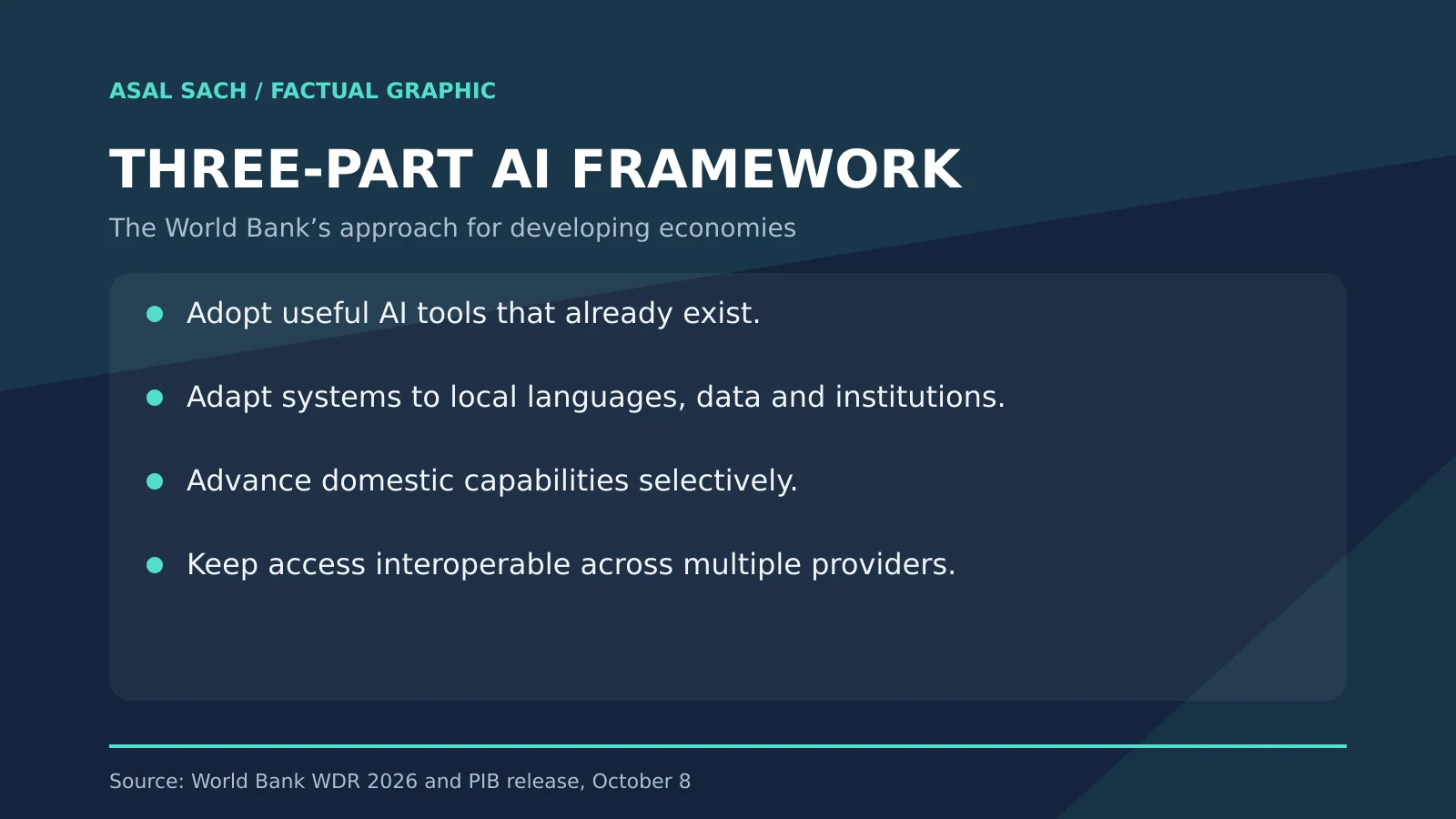
The report’s central framework asks developing economies to adopt useful AI tools, adapt them to local languages, data and institutions, and advance their own capabilities selectively. The World Bank argues that lower- and middle-income countries do not all need to build trillion-dollar frontier models, but importing tools without local adaptation will also be insufficient. It highlights interoperability and access to multiple providers as safeguards against dependence on a single technology stack.
The World Bank says the report examines what AI may mean for 5.6 billion people living in low- and middle-income economies. Its modelling estimates that about 4.5% of jobs in those economies face displacement risk from AI, compared with 14.2% in high-income economies. It also estimates that 16.2% of jobs in developing economies could receive a productivity boost, compared with 18.7% in high-income economies. These are modelled projections, not observed job outcomes or guarantees.
The report describes “small AI”—less resource-intensive systems adapted to specific local tasks—as potentially useful in settings with limited infrastructure. It points to possible applications in health care, weather and farm advisories, teaching and public services. These examples illustrate opportunities identified by the report; they are not evidence that every named application has been deployed successfully or works at scale.
According to the government’s event summary, the New Delhi discussion focused on moving from pilots to evidence-based scale and on building skills, infrastructure and institutions for inclusive use. Speakers discussed local languages and development needs. The launch release did not announce a new binding Indian AI regulation, a fresh budget or funding package, or an implementation deadline.
The verified new development is therefore the October 8 India launch and the accompanying discussion of the World Bank’s framework. The underlying report and its global statistics date to August 4. Any later decision by India to adopt a recommendation, fund a programme or change regulation would require separate verification.